Why would you cut a paragraph you have already learnt?
In a Jeddle interview, a former HSC student describes cutting material from a prepared essay to fit the question in the exam. Around the middle of the clip he talks about adding material for the stimulus and finding language he could cut. His account answers a better question than “How long was his essay?” What earns its place once you know what you have actually been asked?
Suppose you have prepared a paragraph about mourning in Hamlet. Your practice question asks how a disagreement about one word reveals a limit to what another person can know. A paragraph about the atmosphere of the court might have been worth writing in rehearsal. Before copying it into this response, underline the sentence that answers the new question. If nothing is underlined, trimming a few adjectives will save time on the wrong paragraph.
Take your own draft and write the exact question above it. In the margin, finish the sentence “To answer this I need to show …”. Keep that note visible while you edit. If the task has a stated word limit, check the limit on the task itself. One interviewee’s experience cannot supply one for your course.
Which sentence is repeating an observation?
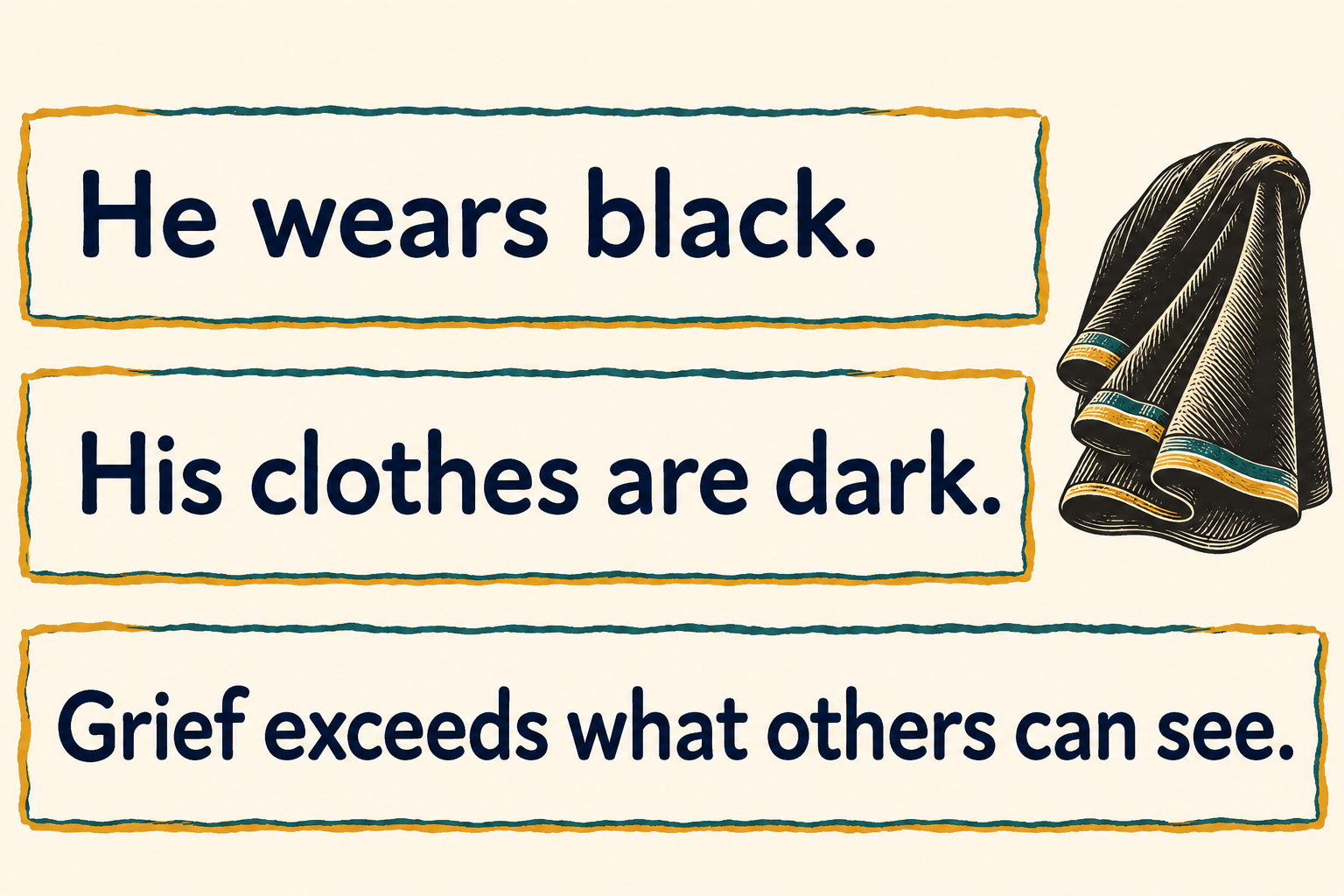
Try the three strips in the illustration. They are practice sentences about Prince Hamlet, written for this exercise. Read them in order. “He wears black.” “His clothes are dark.” “Grief exceeds what others can see.” You can drop one without losing either the observation or the claim. Which one?
The middle sentence repeats what the first one has already established, in less precise terms. Keep the detail about black clothing and the claim about the limits of sight. Then notice the problem that cutting has exposed. The remaining pair still needs a reason to connect clothing with grief. A shorter paragraph can make that missing step easier to spot.
Go to Act 1, scene 2. Gertrude asks Hamlet why his father’s death seems so particular to him. He picks up her word and answers, “Nay, it is.” He goes on to distinguish outward signs of mourning, including the cloak, from what he feels within. Those few words give you more to work with than a second description of his clothes.
How do you shorten the paragraph and keep its reasoning?
Here is an original student-style draft for the question about disagreement over a word. “At this point in the scene Hamlet is speaking to his mother Gertrude about the death of his father. Hamlet is wearing black clothes and the clothes he is wearing are dark. Hamlet is sad about his father. When Gertrude asks why it seems so particular with him, he replies ‘Nay, it is.’ He corrects her choice of word because his mourning has a reality that she cannot fully judge from his clothes.”
Try the cut yourself before reading on. Underline the point at which Hamlet takes issue with his mother. Circle the words that explain why his objection matters. Put brackets round repeated information. If you have bracketed the last sentence just because it is long, read the remainder. You now have an exchange of dialogue, but what does it establish?
One revision reads, “When Gertrude asks why his loss seems so particular, Hamlet objects, ‘Nay, it is.’ Replacing her ‘seems’ with ‘is’, he insists that the outward show of mourning cannot tell her the full measure of his grief.” You can trace the answer from Gertrude’s word to his correction and then to its consequence. Naming the speaker once was enough. Describing black clothing twice did no work for this question.
For a closer look at a different decision in the play, read the guide to character choices in Hamlet. Its example at prayer asks what Hamlet’s delay reveals about revenge. Adding that whole example here would take the reader away from the exchange with Gertrude.
When would you put a detail back?
Change the practice question to “How does Shakespeare use clothing to explore the limits of appearances?” Read the shorter paragraph again. It mentions an outward show, but somebody who had never read the scene would have no idea which piece of clothing supports the answer. Restore Hamlet’s reference to his “inky cloak” and explain the limit he places on that visible sign.
Try this version: “Hamlet points to his ‘inky cloak’, a sign of mourning his mother can see. He insists that such signs cannot convey everything he feels. The cloak makes his loss recognisable at court while leaving its depth beyond Gertrude’s judgement.” A detail you cut for the first question now earns its place. You can check the wording and sequence against the primary text of the scene.
Cover the question and hand someone the revised paragraph. Ask them which question it seems to answer and which detail led them there. If they guess a question about clothes when you meant the argument about a word, you have a concrete decision to make before timing another attempt.
Can you make the same decision on a fresh passage?
Read this original two-sentence scene. “Jai held the envelope up to the light. When his brother came in, he slipped it behind the flour tin.” The question asks how the entrance changes Jai’s behaviour. A practice response reads, “He is in a kitchen. He holds the envelope to the light. The room contains a flour tin. After his brother arrives, he puts the envelope out of sight. The shift from examining it to concealing it makes the arrival feel like an interruption.”
Cut a sentence and defend the cut. One answer is to drop the bare statement that the room contains a flour tin. The room detail by itself does little for this question. Keep the change from examining the envelope to concealing it. If you use the tin, attach it to the act of hiding instead of listing it as furniture. We still cannot tell what is in the envelope. A claim about stolen money would introduce an explanation the passage never gives.
Copy the editing record below for a paragraph you are revising. Keep the original and revised versions side by side long enough to point to what has gone and what has survived. If the only thing you can say about the revision is that it is shorter, try the question check once more.
If this is your set text, the Hamlet study guide takes you further into the play. You can also browse the study guides for another text.
How can you check the cut on your own work?
Put the question and the revised paragraph together when you seek feedback. Ask the reader to mark the exact spot where your explanation depends on words you have removed. If they point to a genuine gap, restore the smallest piece of evidence or reasoning that closes it.
You can try JeddAI on your revised paragraph and compare the feedback with your before-and-after record. Check any suggestion against the scene and the actual question before making a further change.
| Question focus | Evidence to retain | Reason |
|---|---|---|
| Disagreement over a word | Gertrude’s “seems” and Hamlet’s “Nay, it is.” | His correction challenges what she can infer from appearances. |
| Clothing and appearances | Hamlet’s “inky cloak” and his distinction between visible signs and inner grief. | The object gives the reader a specific sign whose limits he explains. |
| Check | Your note |
|---|---|
| The question asks me to show | ___ |
| My claim and the words that support it | ___ |
| The sentence that repeats a job | ___ |
| The reasoning that must survive | ___ |
| What a reader can explain after the cut | ___ |